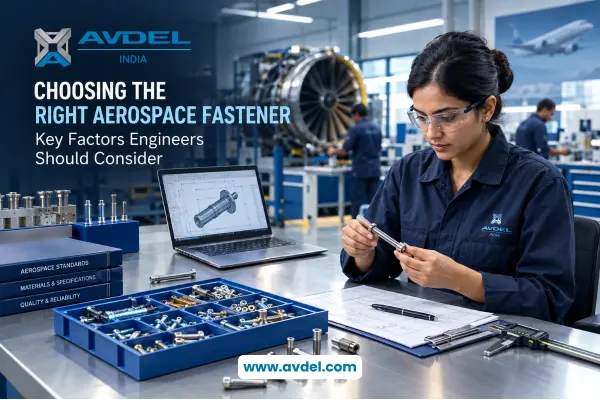
Selecting the right fastener for an aerospace application involves far more than choosing the correct size or strength rating.
Aerospace assemblies operate under demanding conditions, where factors such as mechanical loads, vibration, temperature, corrosion, material compatibility, installation access, and traceability can all influence fastener selection.
For engineers and procurement teams, the challenge is to identify a fastening solution that meets the technical requirements of the application while also satisfying quality, certification, availability, and supply-chain requirements.
This guide outlines the key considerations involved in selecting aerospace fasteners and explains why working with an experienced aerospace fastening partner can simplify the process.
1. Start With the Application
The first step in fastener selection is understanding where and how the fastener will be used.
Before selecting a component, engineers should consider:
- What type of assembly is being joined?
- What loads will the joint experience?
- Is the application structural or non-structural?
- Will the assembly experience vibration or fatigue?
- Is the fastener exposed to moisture, chemicals, or other environmental conditions?
- Is access available from one side or both sides?
- What installation equipment is available?
A fastener that works well in one aerospace application may not be appropriate for another.
The application should determine the fastening solution.
2. Consider the Required Performance
Fastener selection should be based on the performance requirements of the joint rather than size alone.
Depending on the application, engineers may need to evaluate:
Tensile Strength The ability of a fastener to withstand forces that pull the joint apart.
- Shear Strength Important where forces act across the joint.
- Fatigue Performance Aircraft structures can experience repeated loading throughout their operating life. Fastener selection should therefore consider the fatigue requirements of the application.
- Clamping Requirements The fastener must provide the required joint clamping force while remaining compatible with the assembly design and installation process.
- Vibration Resistance Applications exposed to continuous vibration may require fastening solutions designed to maintain joint integrity under dynamic conditions.
3. Select the Appropriate Fastener Material
Material selection is another important consideration.
Common aerospace fastener materials include titanium, aluminum alloys, and high-strength steels, among others.
- Titanium Fasteners Titanium can provide a high strength-to-weight ratio and corrosion resistance, making it suitable for selected aerospace applications where weight and performance are important considerations.
- Aluminum Alloy Fasteners Aluminum alloy fasteners can provide lightweight fastening options for suitable applications. Their use depends on the required mechanical properties and compatibility with the surrounding structure.
- Steel and High-Strength Alloys Steel and other high-strength materials can be selected where specific strength, durability, temperature, or application requirements need to be met.
Important: Material selection should always be based on the applicable engineering specification and the requirements of the particular assembly.
4. Check Material Compatibility
Modern aircraft frequently combine different materials, including metals, alloys, and composite structures.
This makes material compatibility an important part of fastener selection.
Engineers may need to consider:
- Galvanic corrosion
- Thermal expansion differences
- Chemical exposure
- Surface treatments and coatings
- Compatibility with composite materials
- Environmental conditions
Selecting a fastener without considering the surrounding materials can create problems that may only become apparent after installation or during service.
5. Consider the Installation Method
The installation environment can significantly influence which fastener is suitable.
For example, some aircraft structures provide access from only one side. In such applications, blind fastening solutions may offer practical installation advantages.
Other applications may require:
- Conventional fastening
- One-sided installation
- Controlled torque installation
- Specialized installation tooling
- Automated fastening
- Installation in confined spaces
The fastener and installation method should therefore be considered together.
A simple principle:
Fastener Selection + Installation Method = Complete Joint Solution
6. Evaluate Environmental Conditions
Aerospace components may operate in environments involving significant temperature changes, vibration, moisture, pressure variations, and chemical exposure.
Before selecting a fastener, consider:
- Operating temperature
- Humidity and moisture
- Corrosive environments
- Vibration
- Repeated loading
- Exposure to fluids or chemicals
The selected fastener should be appropriate for the expected service environment and the requirements specified for the application.
7. Specifications, Standards and Certification
Technical suitability is only one part of aerospace fastener selection.
The fastener may also need to comply with the relevant customer, programme, industry, or aerospace specification.
Depending on the application, procurement and engineering teams may need to verify:
- Applicable aerospace specifications
- Material certification
- Manufacturer documentation
- Inspection requirements
- Certificate of conformity
- Batch or lot identification
- Traceability requirements
Standards such as AS, NAS, and MS specifications may be relevant depending on the application and customer requirements.
The applicable specification should always be confirmed against the engineering documentation for the specific programme.
8. Don't Overlook Traceability
Traceability is particularly important in aerospace supply chains.
Procurement teams may need to establish the relationship between the supplied component and its:
Manufacturer → Part Number → Batch/Lot → Certification → Customer Application
Proper documentation and identification can support:
- Quality audits
- Incoming inspection
- Regulatory compliance
- Supplier verification
- Non-conformance investigations
- Long-term component records
For critical aerospace applications, traceability is part of the overall product assurance process.
9. Procurement: Is the Fastener Actually Available?
A technically suitable fastener is only useful if it can be sourced reliably.
Procurement teams should consider:
Current availability
- Lead time
- Approved manufacturer/source
- Minimum order quantities
- Inventory requirements
- Documentation availability
- Long-term supply continuity
- Alternative approved solutions where applicable
This is where the role of an experienced aerospace distributor becomes particularly valuable.
A distributor with product knowledge, manufacturer relationships, inventory capabilities, and technical expertise can help connect engineering requirements with procurement realities.
10. A Practical Aerospace Fastener Selection Checklist
Before finalizing a fastener, engineers and procurement teams can work through this checklist:
- APPLICATION: What is being joined?
- LOAD: What tensile, shear, fatigue, or clamping requirements apply?
- MATERIAL: Is the selected fastener material suitable?
- COMPATIBILITY: Is it compatible with the surrounding material?
- ENVIRONMENT: Can it withstand the operating conditions?
- INSTALLATION: What installation method and tooling are required?
- SPECIFICATION: Does it meet the applicable specification?
- TRACEABILITY: Are certification and lot/batch records available?
- AVAILABILITY: Can the required quantity be supplied when needed?
How Avdel India Can Support Aerospace Fastener Selection
Selecting an aerospace fastener often involves coordination between engineering, quality, procurement, and production teams.
Avdel India supports this process by providing access to aerospace fastening products, global manufacturing partnerships, technical expertise, sourcing capabilities, and supply-chain support.
For customers, this can help simplify the journey from:
Application Requirement → Fastener Selection → Sourcing → Documentation → Supply
The objective is not simply to supply a fastener, but to help customers identify and source fastening solutions that align with their application and procurement requirements.
Choosing the right aerospace fastener requires a systematic approach.
Size and strength are important, but they are only part of the decision. Engineers and procurement teams also need to consider application requirements, materials, environmental conditions, installation methods, specifications, traceability, and supply availability.
By evaluating these factors together, aerospace manufacturers can make more informed fastening decisions and build a stronger connection between engineering requirements and procurement.
For organizations looking for technical expertise and reliable access to aerospace fastening solutions, Avdel India provides a combination of product knowledge, global sourcing capabilities, and local support.
The right fastener starts with understanding the right application.
Explore aerospace fastening solutions with Avdel India → www.avdel.com